








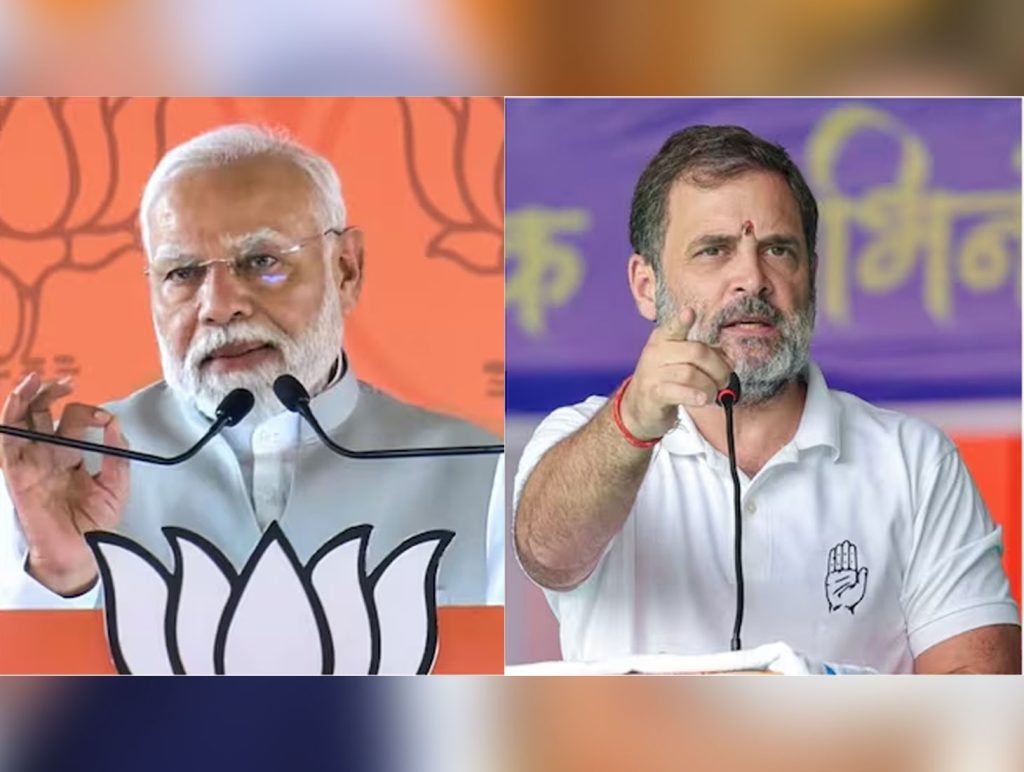

Politics has always been described as the art of the possible. There is an old saying that there are no permanent friends or enemies in politics. Perhaps today’s India demands an update to that maxim. The finest political strategy is often to defeat one opponent with the help of another. Indian politics has repeatedly demonstrated that today’s bitter rival can become tomorrow’s indispensable ally and vice versa.
Over the past decade, India’s political map has been transformed beyond recognition. The BJP, backed by the organisational strength of the RSS, pursued its vision of a “Congress Mukt Bharat”. On the surface, that project appeared to be a direct battle against the Congress. Beneath the rhetoric, however, another story may have been unfolding. What if the real casualty of the last decade has not been the Congress but India’s regional parties?
From the early 1990s until 2014, Indian politics belonged to coalition builders. Leaders such as Mulayam Singh Yadav, Lalu Prasad Yadav, Shibu Soren, J Jayalalithaa, Mamata Banerjee, Parkash Singh Badal and Bal Thackeray shaped politics within their states while influencing governments in Delhi. National governments survived because regional leaders held the balance of power.
The Congress understood this model well. It perfected a political arrangement that can be summed up in a simple phrase. You govern your state while we govern the Centre. Coalition politics allowed the party to remain relevant even when it lacked a parliamentary majority, while regional parties strengthened their own political dynasties.
Then came 2014.
Prime Minister Narendra Modi’s rise fundamentally altered the equation. The BJP was no longer content with leading coalitions. It wanted to become the country’s defining political force. With every election, it pushed into states that had long been regarded as strongholds of regional parties. As those parties began to lose their grip, the BJP steadily emerged as their main challenger and in many places, their replacement.
Its victory in West Bengal in 2026, ending 15 years of Trinamool Congress rule, represented more than another electoral success. It marked another step in dismantling the political order that had shaped India since 1989.
The BJP, however, is only one part of this story.
The Congress, despite remaining out of power nationally for more than a decade, has also watched many of its regional competitors decline. That raises an uncomfortable question. Has the Congress, intentionally or otherwise, benefited from the erosion of regional parties?
Political alliances in India have always been fluid. Rahul Gandhi may sharply criticise Mamata Banerjee during one election campaign before standing beside her under the INDIA alliance banner a few weeks later. Likewise, the Congress’s partnership with Uddhav Thackeray after the split in the Shiv Sena reshaped Maharashtra politics, even though it ultimately weakened the legacy of Bal Thackeray’s original political movement.
Viewed individually, these episodes reflect ordinary coalition politics. Viewed together, they could suggest a broader trend in which regional parties steadily lose ground while the BJP and Congress remain the only truly national competitors.
Is this the result of deliberate strategy or simply the unintended consequence of changing voter behaviour?
Politics, however, often produces outcomes that no single player entirely controls. Parties pursue immediate electoral gains, but those short term calculations can reshape the country’s long term political landscape.
If regional parties continue to shrink, the Congress may eventually discover that its fiercest opponent has also become the architect of its revival. A contest that once involved dozens of influential regional forces could gradually evolve into a straightforward battle between two national parties.
That possibility would have seemed improbable in 2014, when many believed the Congress faced irreversible decline. Today, however, the political arithmetic looks different. The BJP has unquestionably become India’s dominant national force, but the space between the BJP and the Congress may actually be widening at the expense of everyone else.
History often rewards patience in politics.
Perhaps Rahul Gandhi’s electoral setbacks are not merely defeats if they coincide with the decline of regional competitors. Perhaps Narendra Modi’s expansion has unintentionally simplified the battlefield for his principal rival.
Or perhaps none of this is true.
Perhaps it is simply an intriguing political thought experiment.
Yet if even a small part of this interpretation proves accurate, India could be witnessing something remarkable. It may not be the end of one political party but the quiet disappearance of many. In their place, a two party contest may slowly emerge in a country that has long been defined by coalition politics.
If that is where India is headed, history may remember this period not for the fierce clashes between the BJP and the Congress, but for something far bigger. While everyone watched the political battles, the country’s regional parties quietly faded from the centre of Indian politics.
The Congress leadership is expected to hold key discussions on Tuesday over the future of…
It was 2004 when I first travelled across Haryana to cover the Lok Sabha elections…
By mid-morning on Monday, the scenes outside BJP offices across India had already answered the…
When MPs walk out, not one, not two, but seven, it stops being a personnel…